Showing posts with label review. Show all posts

Tuesday, September 12, 2017

Review: In Progress

Look at me, tearing through my L&D "To Read" book pile!


Title: In Progress
Author: Jessica Hische


What's it about?

Jessica Hische may not be a name you're familiar with if you're not in to hand lettering or typography, but given her popularity right now there's a good chance you've seen her work and just not known it. In this book she shares the techniques and processes she uses to create her typography designs.

What's so great about it?

We talk a lot about the idea of "show your work" in L&D and this book is entirely that. Hische outlines her approach to design, the tools she uses, the technical processes she goes through when creating a design, all in conversational language that doesn't require you to be a lettering or design expert to follow along. She also talks about client projects she's worked on, sharing early sketches and her thoughts about how she wanted to best address what the client was looking for.

So this is a great peek behind the scenes at one person's creative process, which is a big reason I enjoyed this so much. It's also a fantastic example of how you yourself can work out loud in a way anyone can follow along with. Even if design isn't your passion, this book gives you great models for how you can pick apart and share you own work openly with others.

What's going to frustrate me about it?

As much as behind the scenes looks at anyone's problem solving process can be helpful, this book focuses a lot on process, so you're going to need to have at least some interest in design, drawing, or typography to really enjoy it. Not in any of those categories? It might be still worth your time to borrow this from the library and just skip to the section where Hische talks about her client work, as there are some good nuggets there about how to solve client requests that anyone might find useful.

Also, are you looking for step-by-step tutorials that will show you how to how to do hand drawn lettering yourself? This isn't that book.

Anything else?

This is a great example of a book that's about a very narrow topic (in this case, lettering) that actually has much broader insights for people in other industries. I wish there were more books out there like this that explored people's work processes in such easy to understand ways.

Related to that, this book is also n excellent example of how to write content that's accessible to non-experts, but doesn't feel too basic for experts. It's impressive how Hische can take her own processes and explain them in ways that feel don't feel confusing to newbies but still have value to experts from her field as well. It's a tough balance to walk, and one we could stand to do more in L&D.

I'm too lazy to Google the book. Where can I buy it?

I've got you covered (Well, at least if you live in North America):

Wednesday, August 17, 2016

Review: Let the Elephants Run


It's really time for me to start blogging again, and what better way to restart than with a review of the book I just finished!


Title: Let the Elephants Run
Author: David Usher


What's it about?

When I was growing up David Usher was mostly known as the lead singer of the Canadian band Moist. In the subsequent years he's also built up a rather interesting reputation as a speaker on how people can become more creative. This book takes the core ideas from his talks and expands on them even further.

What's so great about it?

Are you someone who loves the idea of creativity but doesn't always think of themselves as a creative person? Well then, this book is for you. Everything Usher says in this is meant to help you see that creativity is a skill anyone can build. Through a bunch of mini essays (think Seth Godin length, but in a layout with better graphic design) he expand on the many reasons people believe they aren't creative and the steps and activities they can use to strengthen that skill and use it in a variety of ways.

If you know me or have heard me talk, you know that I absolutely agree with Usher's approach here. Many people have told me that they think creativity is just something you're born with, not realizing the years of practice, experimentation, and just plain willingness to keep going even when you suck at first that has made the people they admire seem just naturally outstanding at coming up with new ideas and approaches. Usher does a fantastic job at pulling back the curtain and showing readers all the sweat and effort that goes into building your creative skills. It's not always pretty, and Usher doesn't romanticize it in the slightest.

What he does do, though, is break down many of the processes people use to spark their creativity and show the reader that this is something that they too can learn how to do with time and practice.

What's going to drive me nuts about it?

Are you someone who already feels confident in their creativity? Then you're probably not going to get much out of this other than a feeling of solidarity with Usher. It's not a waste of your time (and can be a nice way to inspire yourself out of a creative rut), but you were never the intended audience for this book. Maybe buy it as a gift for someone else... like the next person who tells you "Oh, I really just can't be creative like you are."

Also, be aware that the chapters in this are short. I mean, REALLY short. They're much more like reading a bunch of mini articles than a typical book. If that kind of writing frustrates you, this might not be the book for you.

Anything else?

I am overwhelmed with how beautiful this book is. Normally that's not something I would mention in a book review, but it feels well worth mentioning in this one case. A book on creativity should use every tool imaginable to help inspire you, and clearly that idea fueled the graphic design and layout of Usher's creation. Just flipping thought this thing can be enough to help you feel excited about coming up with new ideas.

I'm too lazy to Google the book. Where can I buy it?

I've got you covered (Well, at least if you live in North America):

Saturday, April 27, 2013

Review: Cognitive Surplus


It's book report time again!


Title: Cognitive Surplus: How Technology Makes Consumers Into Collaborators
Author: Clay Shirky

What's it about?

Did you read Shirky's first book Here Comes Everybody? This book is basically its unofficial sequel. While HCE discussed how technology is enabling people to create organizations and movements via social media, this book focuses instead on the power that this same technology gives the average person to both be a media creator (rather than just consumer) as well collaborate in new ways with others.

What's so great about it?

Shirky claims, rightly so in my opinion, that we're in a media revolution of the same magnitude as the invention of the moveable type printing press. The internet, smart phones, computers, social media, and the like have all lowered the bar for creating and distributing content. In addition, they've also made it exceptionally easy for people to collaborate regardless of location, occupation, or traditional hierarchies.

He spends this book outlining how these lowered barriers for content creation combined with increased ability to collaborate is allowing us all to pool our combined knowledge and build on it in ways that would have been previously impossible. He also breaks down the "hows, whys, and whats behind cognitive surplus" and walks through the wide variety of content it's created, from things as inconsequential (but fun) as memes to accomplishments as important as civic movements.

What's going to drive me nuts about it?

The organization of the book content is incredibly tight through most of it. The tail end of the book, though, reads like it was just a collection of the leftover snippets of info that didn't fit neatly into the previous chapters but were too interesting to leave out. It's not bad content, but the randomness of it compared to the tidy order of the rest of the book is a bit jarring.

Anything else?

Do you already participate in Twitter chats, edit Wikipedia, record your own YouTube videos, collaborate via Google Hangouts, or have an online personal learning network?  Chances are you already know the basics that Shirky is covering here. It's still worth reading this book though, if just to give you successful examples to share with others.

In addition, while this book is an enjoyable read for experts, it's also quite accessible to people who don't know much about online collaboration as well. That's a huge plus as far as I'm concerned.

I'm too lazy to Google the book. Where can I buy it?

*sigh* Here you go:

Thursday, February 21, 2013

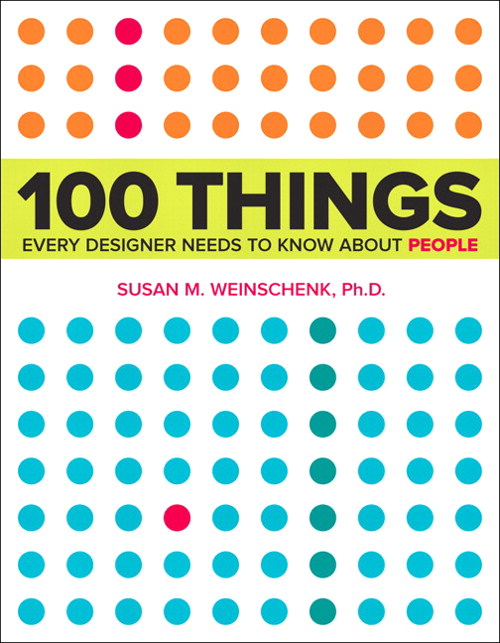
Review: 100 Things Every Designer Needs to Know About People

Work is making me do a book report... A BOOK REPORT!

Okay... by "making me" I mean I volunteered to speak about something I liked at this week's Instructional Design lunch & learn, and now we have to write about what we talked about. I reviewed a book, therefore I'm writing a book report.

Admittedly, it sounds way more amusing the way I initially put it.

Anyway, since I'm writing up this book report for work I figured I may as well share it here too.


Title: 100 Things Every Designer Needs to Know About People
Author: Susan Weinschenk

What's it about?

Never before have you read a title more accurate. It's exactly what it says it is: 100 facts about people (and specifically their minds) that designers, or anyone really, should know.

What's so great about it?

This isn't just a collection of facts based on someone's gut feeling: every point is based on scientific research. This book talks about topics like how people make mistakes, focus their attention, remember, and are motivated, all in layman's terms. It then tells you how you can use these facts to your advantage when designing anything.

So it's brain science in easy to digest nuggets that will help you design your learning/websites/textbooks/apps/whatever in ways that are more effective. Plus, it identifies its sources, so you can check the science for yourself.

What's going to drive me nuts about it?

Because it covers so many individual topics, trying to read this thing cover to cover will give you brain overload. I'd usually make it though about 5-10 topics in a sitting and then have to stop, put the book down, and process. And I say this as someone who's usually happy to read constantly for hours. It's good, but it'll likely be a slow read.

Anything else?

The colour scheme of the book is ridiculously pleasing (what, these things matter to me!).

I'm too lazy to Google the book. Where can I buy it?

*sigh* Here you go: